
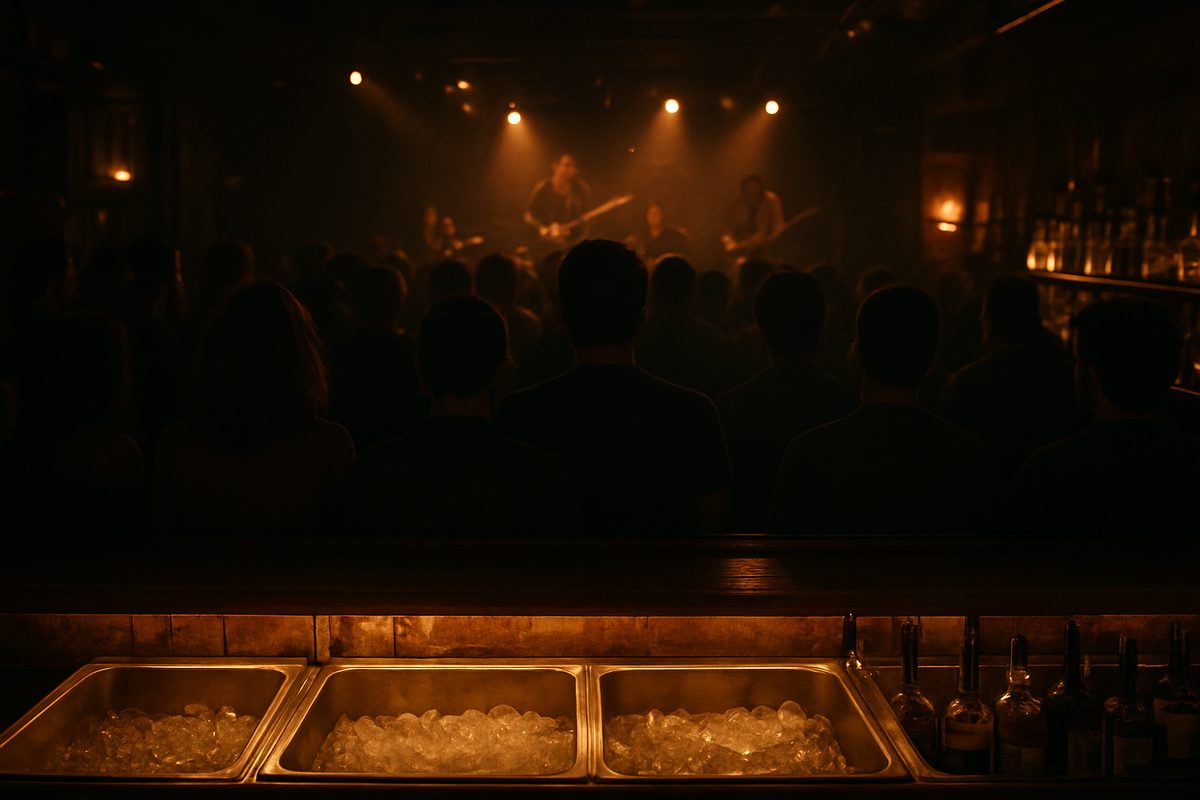
A music night bar hits its real pressure point around the middle of the second set. The floor is full, the opener has just cleared enough room for movement, and the rail goes from two lines to three deep in about four minutes. Nobody is angry yet. They are just thirsty, close together, and trying to catch the bartender’s eye. This is the moment busy bar service stops being about drink knowledge and becomes about system, position, and repetition.
Build the Well Before the Crowd Does
Three deep service does not start when the rail fills. It starts during soundcheck, when the room is still half dark and the only people at the bar are the sound engineer and a few early regulars. That is the time to set the well the same way every night. Every bottle on the speed rack should live in the same slot. Every backup bottle should be within one step of the bartender’s left or right hand. The ice bin should be full enough to bury a bottle of rosé, not just cover the bottom. If the opener runs a short line check at 8:10 and the room starts moving at 9:00, there is no quiet half hour later to fix a misplaced pour.
Busy bar service on a music night is a different animal from a restaurant dinner rush because the crowd arrives in waves. The first wave hits when doors open. The second wave hits when the opener finishes. The third wave hits between sets. A bartender who treats those waves as a steady flow will get buried. Build the well for the worst fifteen minutes of the night, not the average hour.

Good setup also means keeping the garnish tray low and flat, filling the dump sink with fresh water, and lining up glassware in a consistent stack. You do not need a fancy rail. You need a rail that you can work without looking down after the third drink. On a dark music night, your hands should find the bottle by position, not by label.
Service Order Is the Only Fairness System
At three deep, a loose first come first served policy falls apart. The bartender cannot see who arrived first. What works is a visible sweep. Work the rail from left to right, then come back across the center. Say it out loud. A short phrase like, “I see you, two more on your left,” keeps the back row calm. Most people will wait if they know they are in the order. They get difficult when they believe the bartender forgot them.
Keep eye contact moving. Do not stare at the register while the well is full. Take the next order while the current drink is settling or while the card terminal reads. Busy bar service is a constant loop of see, say, pour, pass, repeat. If one guest tries to order for a group of six, take the order, but only fire the first two or three drinks before checking the rail. That keeps one large order from freezing the whole line.
Regulars matter, but they cannot own the first rail position. A quick nod to a familiar face is fine. Pulling a regular ahead of three rows during the headliner’s break only creates a louder problem. Regulars should know the system. If they do not, pull them aside before the rush and explain that the bar moves faster when everyone stays in the sweep.
Three Positions, One Well
On a busy music night, every body behind the stick needs a job that does not overlap. The cleanest setup is point, pour, and pass. The point bartender reads the rail, calls orders, takes payment, and keeps the order sequence. The pour bartender stays in the well, builds drinks, and never leaves the rail. The barback or third person passes glassware, restocks ice, cuts garnish, and clears empties.
In small venues there are often only two people. In that case the bartender is both point and pour, and the barback runs point support. The barback watches the well first and the crowd second. Every time the bartender turns away from the rail to grab a bottle, the service speed drops. The barback exists to remove those turns.
Do not let a server or door person step into the well without a defined role. A helpful person who starts grabbing clean glass from the wrong stack will break the rhythm faster than a ten drink order. If someone jumps in, give them one simple job: clear empties, fill ice, or run food. Nothing else.
Backup Stock and Ice Runs During the Set
Backup stock cannot live in the basement or a dry storage closet. At ten thirty on a music night, a backup bottle that is sixty seconds away might as well not exist. Keep top pouring backups in a low cooler or a bus tub directly below the rail. Keep backup glassware racked within arm’s reach. Keep a second ice bucket on the floor behind the well, covered and ready to dump.
Restock in the gaps. The best time is the last song of a set, when the floor is still full but the rail thins for ninety seconds. The worst time is the first song after a set break, when the whole room returns at once. If you feel the urge to restock during the rush, ask whether the bar is about to run out of something or whether you just want it to look neater. If it is not close to eighty-six, wait.
- Speed rail bottles in fixed order, labels facing up and forward.
- Backup bottles for the top pourers under or beside the well.
- Ice bin full to the bottle level, with a backup bucket inside the bar.
- Garnish tray filled, covered, and set below eye level.
- Glassware stacked by type in the same order as the rail.
- Dump sink clean with a small splash of water.
- Bar towels rolled and placed in two spots, one wet, one dry.

Ice is the first thing to go soft on a music night. A full bin with a barback who knows the ice route keeps the well cold and the pours fast. If the venue has a single ice machine behind the stage or through the crowd, map two routes. The long route avoids the pit but takes more time. The short route cuts through bodies. Use the long route early, the short route only when the bar is about to stop.
Cash, Tabs, and the POS Line
Cash and cards slow down busy bar service if the bartender handles them as an afterthought. Set the payment sequence before the rush. For cards, start a tab early in the night when the guest orders the first round. That turns the second and third rounds into a quick swipe and pour. For cash, keep the bar simple. Take the order, pour, then make change. Do not stop to count ones while three rows wait.
Repeat every order back before you pour. A short readback like, “Two lagers, one rocks, and a soda water,” catches mistakes before they become remakes. A remake at three deep costs more than the drink. It costs the trust of the rail and the flow of the whole well.
Keep the card terminal away from the wet rail. Mount it on a dry shelf or hand it to the guest on the back side of the bar. Wet hands and card readers do not mix. If the terminal freezes or the drawer jams, call it out and shift that lane to cash or tab only. Do not stop the whole bar to fix a machine.
Communication Between Barback and Bartender
Full sentences do not work over a live band. Busy bar service needs short rail calls. “Ice low.” “Backup rail.” “Eighty-six ginger.” “Glass below half.” The barback repeats the call. No arguing, no long explanation. If the bartender calls for more ice, the barback says “ice coming” and moves.
A good barback looks at the well, not the crowd. The barback should know which bottle is close to empty before the bartender asks. That means watching the speed rack, not the stage. It also means clearing empty glassware from the rail every few minutes. Empty bottles and used cocktail napkins create visual noise. A clean rail helps the bartender see the next order and helps the guests see the bar is moving.
Use hand signals for the common problems. A flat hand sliding down means ice. A pointed finger at a bottle means backup. A raised empty glass means glassware. The signals should be simple enough to read across a dark room. The guest does not need to understand them, but the barback does.
Handling the Crowd at the Rail
Three deep is crowded but usually still controlled. Four deep is where the problems start. The bar team needs to watch the rail not just for orders but for pressure. If the front row is being crushed against the wood, the bartender should slow the pour and call security. A spilled drink is easier to fix than a panicked crowd. Keep a clear lane at the server pickup end of the bar. Do not let that lane become standing room.
Use the rail to direct traffic. Tell guests waiting for a tab to step to the side. Tell guests who only want water to use the water station if the venue has one. A simple “water is at the end of the rail” removes a low value order from the well and keeps the paying line moving. It also helps people who are already drunk stay hydrated.
Do not serve someone who is visibly falling over, even if they are polite. A music night crowd often pushes people to the bar who should not be there. Have a code word with security for a guest who needs water and a chair. The bartender is not a bouncer, but the bartender is the first person to see a problem forming.
Close the Night Without Letting the Bar Collapse
Last call on a music night is not the end of the work. The bar has to survive the final rush, clear the room, and reset for the next day. Do not start breaking down the well while the headliner’s last song is still ringing out. That only invites a second rush of people who think the bar closed early. Keep the rail intact until the lights come up.
When the crowd thins, start the reset in order. Count the drawer. Close open tabs. Pull and label 86’d bottles. Wipe the speed rack. Dump and refill the ice bin if it has gone slushy. Empty the dump sink. The close is easier if the barback and bartender clean as they go during the last set. A few minutes of quiet wiping during a slow song saves twenty minutes of hard cleaning after doors.
- Count the bank and close card tabs before moving any stock.
- Wipe every bottle on the speed rack and return it to its slot.
- Empty, rinse, and dry the dump sink.
- Restock the rail for the next shift, not the next day.
- Check the floor behind the bar for broken glass and wet mats.
- Close the ice bin and cover open garnish.
- Write a short shift note for the next bartender about low stock or broken equipment.
The real test of busy bar service is not how fast the drinks went during the peak. It is whether the bar could open the same way tomorrow night without someone redoing the whole setup. The best music venue bars look calm on the outside and run on a fixed system underneath. The crowd feels the rhythm. The bartender keeps the rail moving. And the night ends with a clean well, a counted drawer, and no surprises.