
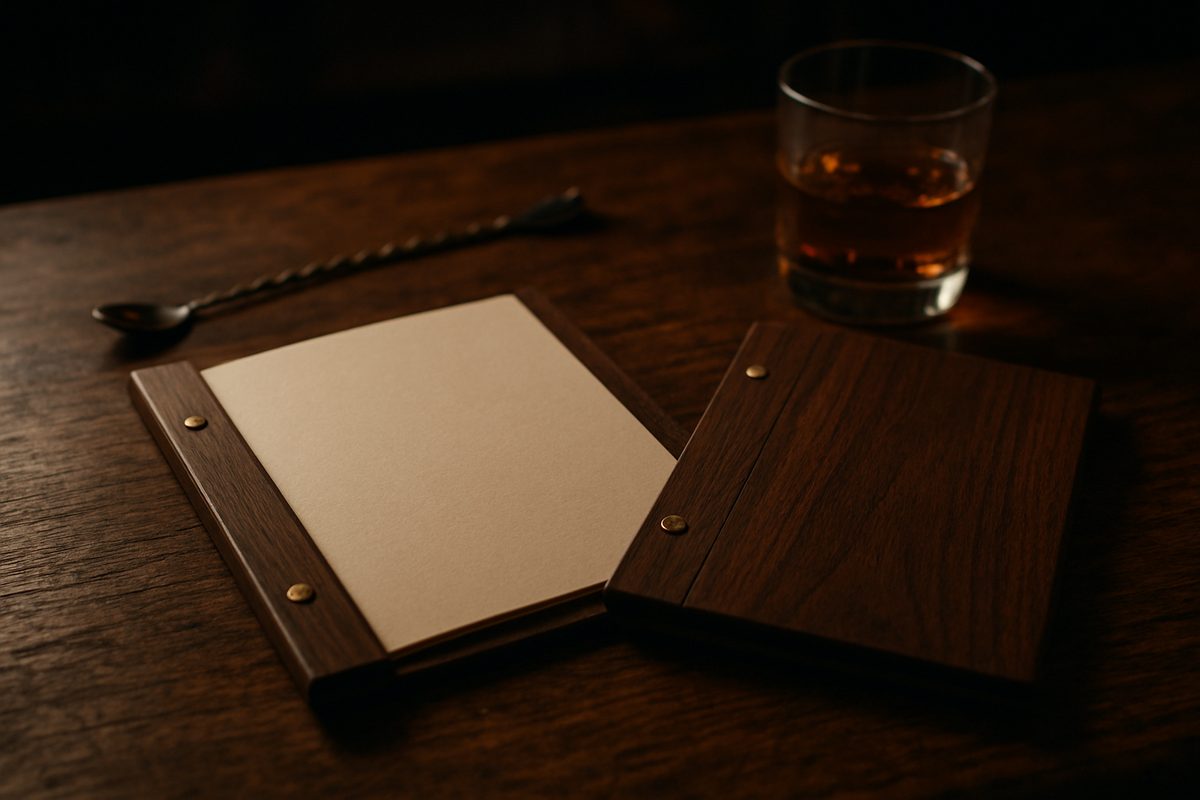
Wooden menu covers are one of those small purchases that quietly shapes the whole service flow. In a bar, especially on a music night, menus get dropped, stacked, wiped down, and shoved between bottles. A flimsy cover warps and stains. A well-made wooden cover holds its shape, protects the printed menu, and gives the bar a more finished feel without requiring constant replacement.
Why Wooden Menu Covers Earn Their Place Behind a Bar
A wooden menu cover does more than look good. It adds mass, so a menu does not slide off the edge when a server sets a tray down. It keeps the paper insert flat and dry. It also takes the small hits that would chew up laminated paper or thin plastic. For a venue that runs live music, those details accumulate over a busy weekend.
Wood absorbs impact better than laminated card or thin plastic. When a customer knocks a stack of menus off the edge of the bar, wooden covers tend to dent or scuff instead of cracking. That matters in a music venue, where every flat surface near the stage becomes a landing zone for drinks, phones, and elbows. A broken plastic cover becomes trash. A scuffed wooden cover often still works for years.

Material Choices and Board Construction
Not every wooden cover is built for bar service. The way the board is cut, glued, and finished decides whether it stays flat after a month behind the stick.
Solid Wood Versus Plywood and Veneer
Solid hardwood has a natural feel and can be sanded and refinished, but it moves with changes in humidity. A solid board that sits near a glass washer or an open patio door can cup or warp. A plywood core with a real wood veneer tends to stay more stable because the cross-laminated layers resist movement. That stability is useful in a bar, where air changes all night.
Veneer surfaces still look like wood and take stain or finish well. The edge treatment is the weak point, so it pays to check whether the edges are sealed and rounded. If the edge veneer lifts, moisture gets underneath and the cover starts to separate.
Thickness, Edge Profile, and Corner Wear
Most bar covers run between a quarter inch and three-eighths inch thick. Thin enough to stack, thick enough to feel substantial. The edge profile matters more than many operators expect. A sharp square edge dents and splinters. A slight roundover or bevel holds up better and feels better in a customer’s hand.
The corners take the worst abuse because covers get dropped on those points. Rounded corners reduce splitting. Recessed hardware protects both the wood and the bartender’s hands.
- Quarter-inch to three-eighths-inch thickness for a balance of weight and durability.
- Rounded or beveled edges to reduce splintering and chipping.
- Rounded corners that survive drops onto tile and concrete.
- A stable ply or cross-laminated core to resist cupping near heat and moisture.
Finishes That Survive Beer, Citrus, and Sanitizer
The finish is the working surface of a menu cover. It has to stand up to condensation, splashed beer, lime juice, hand sanitizer, and the cleaning chemicals used at close. A bare oil finish can look great, but it may need more frequent attention. A film-forming finish is usually the practical choice for a high-volume bar.
Polyurethane and catalyzed lacquer finishes form a sealed layer that wipes clean easily. They resist acid and alcohol better than plain oil. The tradeoff is that film finishes can scratch, and deep scratches leave a visible line. Satin finishes hide wear better than high gloss. A matte or satin surface also reduces glare under low bar lighting, which helps guests read the menu without tilting it toward a candle.
Whatever finish you choose, it should be food-safe once cured. Ask the supplier for documentation. If the cover is used on tables where food is served, do not assume every wood finish is suitable for that contact.
Hardware, Binding, and Menu Inserts
Hardware is where many wooden covers fail. A panel can be beautiful, but a loose screw post or a corroded ring mechanism turns a menu into a mess during service. When you compare wooden menu covers for bars across suppliers, ask for a sample with the exact finish and insert hardware you intend to run. A sample lets you test how the cover opens, how the insert lies, and how the hardware feels after wet hands have touched it.
Screw Posts, Ring Mechanisms, and Magnetic Clips
Screw posts, often called Chicago screws, are a common choice. They bind the front and back panels and hold the insert in place. They are easy to swap when a menu changes, but they can loosen over time. A small drop of removable thread locker can help, though that adds a step for the person updating menus.
Three-ring mechanisms make it easy to change pages, but the mechanism can snag on bar towels and skin. If you choose that style, look for rounded rings and a low-profile spine. Magnetic clip systems hold a single sheet or a small stack and allow fast replacement, but magnets can fail if the clip is knocked hard against the edge of the bar.
Standard Insert Formats and Reprint Workflow
The cover is only half the system. The insert has to be produced quickly when prices change or a new band night menu drops. Most bars run 8.5 by 11 inch inserts, half-sheet inserts, or a narrow 4 by 8 inch format for drink lists. The cover should be sized to a standard sheet you can print in house, not to a custom die-cut that requires a special order.
Keep a digital template for each cover size and a box of pre-trimmed inserts in the office. On a music night, a ripped or stained insert should be replaced in under a minute, not after a trip to a print shop.
Music Night Service Under Load
Live music changes the way menus are handled. The bar is loud, the lights are low, and the floor is packed. Menus get picked up and abandoned at the rail, stacked under bus tubs, and wiped down between sets. A cover that works at a quiet wine bar may not survive that rhythm.
On busy nights, treat the menu cover as a service tool, not a decorative object. That means checking the stack during pre-shift setup, replacing any loose inserts, and wiping down the covers with a dry or barely damp cloth before doors open. A small prep routine prevents a server from handing a customer a sticky cover during the second set.
The cover also has to work in low light. Dark wood with a matte finish reads better than glossy black plastic. The insert itself should be printed in large enough type to be read under a stage light spill, not in the dimmest corner of the room. If your menu changes nightly for music bookings, use a cover that opens flat and lets you swap sheets without tools.

Bus tubs are the final test. Covers thrown into a tub with glassware and dishes will get wet and scratched. Rounded edges and a sealed finish keep that damage on the surface, where it can be cleaned or refinished. Sharp corners and exposed grain invite moisture into the board.
Cleaning and Maintenance Without Ruining the Finish
The biggest mistake is treating a wooden cover like a glass or a plate. It should never soak in a sanitizer bucket or go through a dish machine. Water that sits on the wood works into the joints and hardware. The finish may protect the surface, but the edges and screw holes are entry points.
A simple closing routine works best. Wipe each cover with a damp cloth and mild dish soap, then dry it with a clean towel. For heavier grime, use a food-safe wood cleaner that is compatible with the finish. Do not use abrasive pads or citrus-based degreasers unless the supplier confirms they are safe for the coating.
- Wipe down covers with a damp cloth and mild soap at the end of the night.
- Dry the covers immediately and store them flat or standing on edge.
- Check screw posts and corner hardware during pre-shift setup.
- Keep a small supply of replacement screws, posts, and inserts in the office.
When to Replace or Refinish
Wooden covers can be refinished, but bar operators should weigh the downtime against the cost of replacement. A deep scratch or a worn edge can often be sanded and resealed if the core is still flat. Lifting veneer is harder to repair. If the layers are separating, the cover has usually reached the end of its service life.
Loose hardware is a maintenance issue, not a reason to replace the entire cover. A stripped screw hole can be filled and redrilled, or a larger screw post can be used. The exception is a cover that no longer holds the insert flat. If the menu sheet slides out or bunches when a customer opens the cover, it slows service and looks careless.
Specification Checklist for Bar Owners and Venue Managers
When ordering wooden menu covers for a bar, write down the conditions they will actually face. That includes whether the bar has live music, late-night food service, outdoor seating, or a dish pit close to the front. Those factors change the finish and core you need.
- Wood species and core material, with a preference for stable ply or cross-laminated board.
- Food-safe finish type and sheen level.
- Exact insert dimensions and mounting method.
- Corner profile, edge profile, and hardware style.
- Weight per cover and total menu count.
- Cleaning protocol for front-of-house staff.
- Replacement parts for screws, rings, or clips.
A good wooden menu cover is not a one-time purchase. It is a small piece of bar equipment that gets touched by every customer and every server. When the board, finish, and hardware are matched to the room, it holds up to the wet, dark, fast conditions that define a live music bar.